
When Italian Echoes Found Me 6,000 Miles from Home: A Love Letter to La Bohème
 Entry of the OperaWise Program
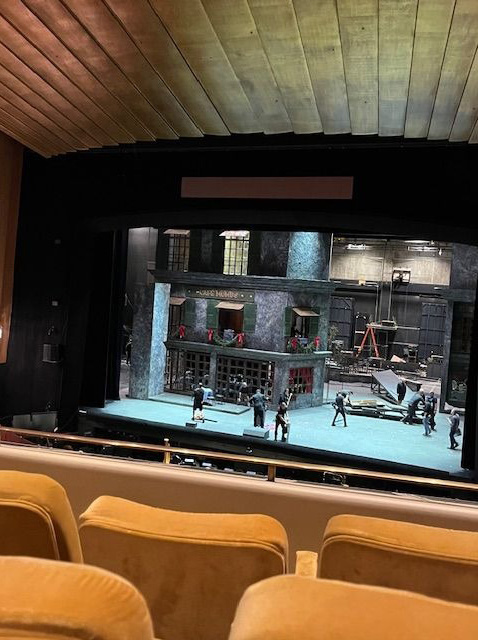
The November air was 50 degrees when we lined up outside the Dorothy Chandler Pavilion. I adjusted my layers—comfortable but warm, as the email instructed—and felt my heart racing. It had been so long since I’d heard Italian sung like this.
I’m from Verona. Yes, that Verona—Romeo and Juliet’s city, but more importantly to me, the city of opera. The Verona Arena has been the world’s largest open-air opera venue since 1913, hosting performances under the stars in an ancient Roman amphitheater for over a century. Opera isn’t just entertainment there—it’s in our DNA, our streets, our history.
But tonight, I was 6,000 miles from home, about to experience Puccini in Los Angeles through the OperaWise program—a free opportunity for college students to witness an orchestra technical rehearsal.
The OperaWise program offered us something rare and precious: access to an orchestra technical rehearsal—that electric, unrepeatable moment when all the elements converge for the very first time. We filed into the Dorothy Chandler Pavilion, that grand dame of Los Angeles culture, dedicated in 1964 as “A Living Memorial to Peace”. For decades, it hosted the Academy Awards; today, it stands as the home of LA Opera, the fourth-largest opera company in the United States. The space itself commands reverence—those grand chandeliers, the sweeping architecture, the sense that important things happen here.
But we weren’t there for the glamour. We were there for the truth.
I found my seat and placed my backpack beneath it, laptop tucked away as instructed. No recording devices. No food or drink past 6:15 p.m. Just us, the performers, and the raw vulnerability of a first run-through. The stage stood ready, costumes prepared, the orchestra pit alive with tuning instruments. And then, in that held-breath moment before the downbeat, I felt something unlock inside me.
The Language That Remembers
“Nei cieli bigi…”
When the first Italian words floated from the stage, something cracked open inside my chest.
You can live far from home. You can adapt to new languages, new customs, new ways of being. But hearing Italian sung in opera—true Italian opera, Puccini’s Italian, with all its melodic cadence and emotional weight—is like hearing your mother’s voice call you home for dinner when you were seven years old.
It wasn’t just language. It was a memory. It was every summer evening in Piazza Bra, waiting for the opera to begin as the sun set behind the Arena’s ancient arches. It was my grandmother’s voice explaining the story of Mimì and Rodolfo, teaching me that opera tells the truths that ordinary words cannot reach.
Giacomo Puccini wrote La Bohème in 1896, and it has become one of the most performed operas in the world for a reason: it speaks to something universal and achingly human. The opera explores themes of love, art, personal freedom and the fragility of life—the way young dreams collide with harsh reality, the way passion burns brightest just before it dies.
The Story That Never Ages
The plot unfolded before us with devastating simplicity: Rodolfo, a struggling poet in bohemian Paris, burning his manuscripts just to keep warm in his freezing garret. Mimì, a fellow tenant with a deadly illness hidden beneath her gentle exterior. A chance meeting on a winter’s night, a dropped key, hands touching in the darkness, and suddenly—love. Impossible, inconvenient, doomed, and absolutely inevitable love.
Oreste Cosimo sang Rodolfo with a tenor that soared and broke in equal measure, while Janai Brugger brought to Mimì a fragility that made you want to protect her even as you knew you couldn’t. The second couple—Marcello (Gihoon Kim) and Musetta (Erica Petrocelli)—provided the tempestuous counterpoint, their on-again, off-again relationship crackling with the kind of passion that’s equal parts joy and warfare.
But this wasn’t a finished performance. This was the technical rehearsal, the moment where things can—and do—go imperfectly. A missed cue here, a lighting adjustment there, the conductor Lina González-Granados pausing to refine a passage, then sweeping the orchestra back into Puccini’s transcendent score. This was creation in real time, the honest work of bringing beauty into being.
And somehow, that made it more moving. Not less.
Sitting in that auditorium, I found myself thinking about bohemia—not just the Paris of Puccini’s imagination, but the bohemia we all carry. The bohemia of being young and broke and passionate about something the world doesn’t value enough to pay for. The bohemia of choosing art over comfort, dreams over security, love over logic.
I thought about why I’m here, so far from Verona. Why any of us leave home. We’re all a little bit Rodolfo, burning our manuscripts for warmth, hoping our words mean something. We’re all a little bit Mimì, hiding our vulnerabilities while searching for connection in a cold world.
The Italian lyrics washed over me, and I didn’t need the English subtitles projected above the stage. I knew these words. I’d known them since before I could remember learning them. They’re part of the cultural DNA of every Veronese child, embedded as deeply as the stone of the Arena itself.
“Che gelida manina…” (Your tiny hand is frozen…) “Mi chiamano Mimì…” (They call me Mimì…) “O soave fanciulla…” (Oh lovely girl…)
These aren’t just arias. They’re the vocabulary of longing, the grammar of heartbreak, the syntax of every love that ever knew it couldn’t last.
There’s something profound about witnessing an orchestra technical rehearsal that you don’t get from a polished performance. You see the scaffolding of art, the framework beneath the beauty. You hear the conductor stop and restart, adjusting dynamics, clarifying intentions. You watch singers move through blocking while holding their music, not yet fully embodying the characters but beginning to find them in their bodies.
Director Brenna Corner’s production, based on Herbert Ross’s timeless vision that the Los Angeles Times praised as a “warm, nostalgic evocation of Paris in Puccini’s time,” wasn’t yet complete. But its bones were visible, and they were strong.
The orchestra—oh, the orchestra. Puccini’s score for “La Bohème” is drenched in lush Romanticism, gorgeous melodies that stick in your heart like splinters of beauty you can’t extract. Hearing it in the pit, watching the musicians’ concentration, feeling the sound build from individual instruments into this overwhelming collective voice—it reminded me that opera is ultimately a communal act. Dozens of people, hundreds of hours, countless individual decisions all converging into one shared moment of transcendence.
The Universal Language of Loss
The opera runs approximately two and a half hours, including one intermission, but time moved differently in that space. We were in Puccini’s Paris, freezing in a garret, celebrating Christmas Eve in the Latin Quarter.
By the time we reached Act IV—when Mimì, dying of tuberculosis (or consumption, as they called it then), returns to Rodolfo one last time—the technical nature of the rehearsal had fallen away. Yes, there were still stops and starts. Yes, the lighting wasn’t perfect. Yes, this was a work in progress.
But the emotional truth was complete.
Tuberculosis in “La Bohème” is more than a plot device; it’s a metaphor for all the ways poverty kills dreams, for how social inequality is literally deadly, and for the reality that love isn’t always enough to save someone. Mimì’s death—slow, inevitable, and heartbreaking—forced every person in that auditorium to confront the fragility of life, the cruelty of circumstance, and the inadequacy of passion in the face of real-world suffering. I felt my own throat tighten. This was why we were here. Not for perfection, but for truth.
Coming Home Through Music
As we filed out into the November night, the cold air hitting our faces like a gentle slap back to reality, I realized something: I hadn’t felt homesick in that theater. I had felt home. Verona will always be in my blood. The Arena will always be my first opera house. But sitting in the Dorothy Chandler Pavilion, listening to Italian sung with passion and skill, surrounded by other students who had chosen to spend their evening in the company of a 130-year-old opera about poverty and love and death—I understood that opera itself is home.
It doesn’t matter if you hear it in the ancient Roman amphitheater of Verona or in a midcentury modern pavilion in Los Angeles. It doesn’t matter if it’s a gala opening or a technical rehearsal with rough edges showing. What matters is the collective agreement to let music carry emotional weight that speech cannot bear.
LA Opera has been producing opera since 1986, building a tradition in a young city, proving that opera isn’t just for Europe’s ancient stones but for anywhere people gather to witness beauty and pain transformed into art.
And “La Bohème,” with its themes of love, art, and the memories of youth, continues to resonate because it captures something timeless about the human experience: the tension between dreams and reality, the way we burn bright and brief, the cruel arithmetic that says passion and longevity rarely coexist.
The Echoes We Carry
I thought on the bus ride home, about Puccini. He never saw Verona’s Arena become all great opera composers’ un-era venues—he died in 1924, just 11 years after the first “Aida” rang out from those Roman stones. But he would have loved it. He understood what all great opera composers understand: that music is the only language capacious enough to hold our largest emotions. Being from Verona, I’ve sometimes taken opera for granted. It was always there, woven into the fabric of everyday life, as common as good wine and old architecture. Moving away gave me the strange gift of rediscovering it as something precious, not by default.
That technical rehearsal of “La Bohème”—with its stops and starts, its visible seams, its honest labor—reminded me why opera endures. Not because it’s perfect, but because it’s willing to reach for impossible beauty knowing it will fall short. Because it insists on grand emotion in an age of ironic detachment. Because it believes that stories about poor artists and dying seamstresses in 19th-century Paris can still break open the hearts of students in 21st-century Los Angeles.
The OperaWise program is free, offered as a gift to students of all disciplines, because LA Opera understands that opera isn’t just about music—it’s about theater, design, language, history, human psychology, social commentary, and the simple, profound act of witnessing others’ stories unfold. I’m grateful I said yes to that opportunity. Grateful for the no-food, no-drink rules and the 50-degree evening and the prohibition on recording. All of it forced us to be present, to experience rather than capture, to let the moment be itself instead of trying to preserve it.
What Remains
As I write this now, I can still hear fragments of that rehearsal playing in my mind. Rodolfo’s soaring tenor. Mimì’s delicate soprano turning to ash in the final act. The orchestra swelling underneath, carrying the weight of every emotion the characters couldn’t speak. I can still feel what it was like to hear my language sung with such care and craft by performers who may not be Italian but who understood something essential about Puccini’s music: that it demands both technical excellence and emotional nakedness.
To anyone reading this who has never been to an opera, who thinks it’s too fancy or too foreign: find a way to go. Not necessarily to a gala performance (though those are beautiful too), but to something like this—a rehearsal, a preview, a moment when the art is still becoming itself. Opera is not a museum piece. It’s living, breathing, constantly renewed with each performance, each interpretation, each generation of singers and musicians and audiences willing to step into a darkened theater and agree, collectively, to feel something big. And if you’re far from home, if you’re carrying the weight of distance and difference, if you sometimes wonder whether you’ll ever feel truly rooted again: find the thing that sounds like home to you. For me, it’s Italian opera. For you, it might be something else entirely. But when you find it, let it hold you. Let it remind you that home isn’t just a place—it’s a frequency, a resonance, a set of vibrations that can reach you anywhere in the world if you’re willing to listen. “Vecchia zimarra, senti…” (Old coat, listen…) Colline sings in Act IV, bidding farewell to his shabby overcoat, that faithful companion of his poverty. It’s a minor moment in the opera, easily overlooked, but it contains such tenderness for the objects and experiences that accompany us through our struggles.
I thought about that on the bus home, clutching my backpack, my old companion through late nights and long days far from Verona. About how we carry home with us in unexpected ways. About how sometimes you have to travel 6,000 miles to understand what you’ve always had. “La Bohème” ends in death, but it lives in memory—in the way Rodolfo will carry Mimì’s love for the rest of his life, in the way we carry the art that moves us, in the way I will carry that November night in the Dorothy Chandler Pavilion, hearing Italian echoes find me in the California darkness and whisper, gently, benvenuto a casa—welcome home.
“La Bohème” continues its run at LA Opera at the Dorothy Chandler Pavilion. For more information about OperaWise and other community programs, visit laopera.org.