
The Usefulness of the Useless
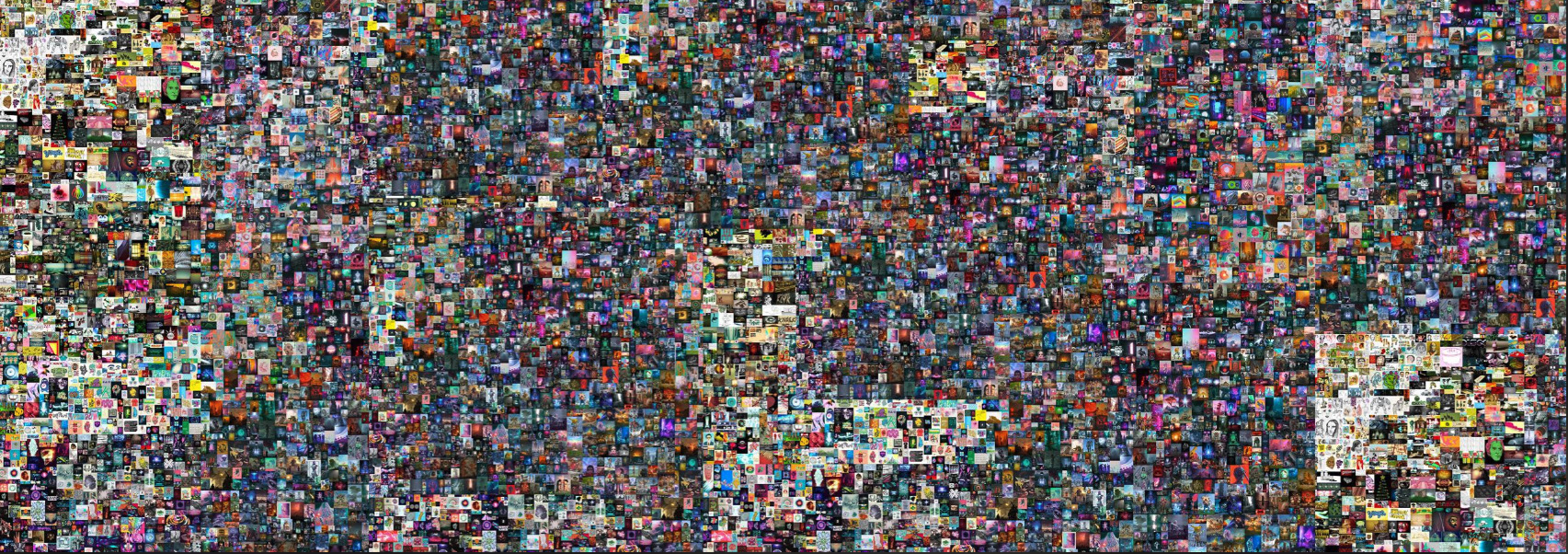 Beeple’s digital collage Everydays: The First 5000 Days – a JPEG file – was minted as a unique NFT and sold for $69.3 million.
In March 2021, a digital collage file by the artist Beeple sold for an astonishing $69 million at Christie’s auction. The buyer of this NFT (non-fungible token) didn’t receive a physical object or exclusive rights to the art — essentially, they paid for a certificate of ownership recorded on a blockchain. In practical terms, what they bought has no intrinsic use: it’s a JPEG image anyone can copy. As one tech reporter put it, NFT buyers are often “just buying bragging rights and an asset they may be able to resell later.” How can something seemingly useless command such tremendous value?
These examples highlight a fundamental question: Is value intrinsic or assigned by human systems? Why do humans often prize things with no obvious utility — whether digital art, luxury baubles, or idle pastimes — and even construct entire economies and meanings around them?
Zhuangzi’s Wisdom: Embracing Uselessness
This mystery is not new. Over two millennia ago in China, Zhuangzi (Chuang Tzu) playfully illustrated the “use of uselessness.” In one story, Zhuangzi’s skeptical friend Huizi complains that Zhuangzi’s philosophical musings are “useless.” Zhuangzi responds with a thought experiment: Imagine a person standing on a vast expanse of earth — they only use the patch of ground under their feet. If all the earth around that spot were dug away into a deep pit, what then? Huizi admits that ground would become impossible to use. “It is obvious, then,” Zhuangzi concludes, “that the useless has its use.” In other words, seemingly useless “extra” space — the earth not directly under our feet — is precisely what makes the useful part functional.
Zhuangzi drives home this lesson with vivid parables. He describes a giant, gnarled tree so misshapen that no carpenter wants it; deemed useless as timber, it’s left standing for decades. The tree proudly tells the woodcutter that if it were useful (straight and fine-grained), it would have been cut down long ago — its very uselessness is keeping it alive and flourishing. In the meantime, that crooked old tree provides ample shade for animals and weary travelers to rest. What a conventional mindset calls “worthless” ends up priceless for those who enjoy its shade and for the tree’s own survival. Zhuangzi suggests we “plant” ourselves in that mindset: “Why not plant it in the wilds, in the wide and boundless earth,” he advises, “and stroll idly by its side… wander in ease under it? Axes will never shorten its life… If it has no use, it’s safe from harm.”
Zhuangzi even chides his friend Huizi for a failure of imagination. Huizi once grew an enormous gourd and complained it was too awkwardly large to use; he smashed it as “useless.” Zhuangzi laughed that Huizi was “dense when it comes to using big things,” pointing out he could have turned the giant gourd into a boat and floated around in leisure! The gourd’s value was lost only because Huizi tried to use it in a conventional way instead of seeing its unorthodox potential. Zhuangzi’s Taoist perspective celebrates looking beyond immediate utility, finding freedom and longevity in being “useless,” and creative value in playful, novel uses of things. As Zhuangzi wrote, “Everyone knows how useful it is to be useful, but no one knows how useful it is to be useless.”
Luxury, Leisure, and Status
If Zhuangzi saw value in the useless by transcending material concerns, Western economists later noticed that material uselessness itself can confer value in social contexts. In 1776, Adam Smith noted the famous diamond-water paradox: “Nothing is more useful than water: but it will purchase scarce anything; a diamond, on the contrary, has scarce any value in use; but [it] may frequently be had in exchange for a very great quantity of other goods.” In other words, vital water is cheap, while useless glittering stones are costly.
In 1899, economist Thorstein Veblen famously analyzed this habit of the affluent in The Theory of the Leisure Class. He observed that the wealthy engaged in “conspicuous consumption”— lavish spending on goods and activities precisely because they serve no practical purpose other than signaling status. “Conspicuous consumption of valuable goods is a means of reputability to the gentleman of leisure,” Veblen wrote. In other words, owning expensive, functionally unnecessary items sends a social message: I am wealthy and powerful enough to afford this useless luxury.
Luxury art markets recently serve as a good continuing example. A decorative painting or digital artwork does not feed or shelter anyone, yet art can become an astronomical store of value in human society. The $69 million Beeple NFT sale mentioned earlier positioned the artist among the “top three most valuable living artists” overnight. Why would collectors spend so much on a digital image? Part of it is speculative investment (hoping to resell at a profit), and part is the prestige of owning something unique and culturally notable. As the Christie’s specialist who organized the sale noted, buyers see these digital collectibles as the “next chapter of art history,” eager to get in early. In essence, the market assigned enormous exchange-value to a digital item with negligible use-value. Such value is not intrinsic to the object — it exists in the minds of people. Indeed, anthropologists note that value is a fluid, social phenomenon: what is considered valuable in one era or context may be worthless in another, and vice versa. Today’s prized NFT can become tomorrow’s forgotten meme.
Meaning, Work, and “Bullshit Jobs”
The impulse to find value in useless things isn’t just about flaunting wealth — it also touches on meaning and self-worth. Nowadays, we have also created a vast number of jobs that even the people doing them secretly suspect to be pointless. Anthropologist David Graeber drew attention to this in his book Bullshit Jobs. He defined a “bullshit job” as “paid employment that is so completely pointless, unnecessary, or pernicious that even the employee cannot justify its existence.” Graeber was struck by surveys showing huge fractions of workers who feel their jobs contribute nothing meaningful. (In one 2015 poll in the UK, 37% of workers said their job made no meaningful contribution to the world, with another 13% unsure.) Paradoxically, many of these are well-paid white-collar positions — consultants, corporate lawyers, PR coordinators — that exist in part because of corporate or bureaucratic self-perpetuation. Meanwhile, truly vital jobs (teachers, nurses, sanitation workers) often receive lower pay and prestige. It’s as if our economic system sometimes rewards uselessness (in terms of social value) over usefulness, flipping Zhuangzi’s wisdom on its head.
Why would a society do this? Graeber argued that some “useless” jobs persist because of status quo inertia and a work ethic that equates busy-ness with merit. There’s a cynical view that powerful interests prefer to keep people busy in employment, however meaningless, rather than free with too much spare time (an echo of the old saying “idle hands are the devil’s workshop”). There’s also psychological comfort for individuals and institutions in feeling useful, even if that usefulness is an illusion of paperwork and meetings. It’s telling that early 20th-century economists predicted a very different future: in 1930, John Maynard Keynes imagined that by our era, technology would advance so much that people would only need to work 15 hours a week, devoting the rest of their time to leisure and creative pursuits. Technologically, Keynes was right — our productivity and automation have soared — yet people in 2025 are as busy as ever. Rather than ushering in a golden age of free time, increased efficiency has often just led to new forms of consumption and new kinds of make-work to occupy us. We seem to have trouble valuing leisure for its own sake, even though leisure (the freedom to do “nothing useful”) can be deeply useful for our well-being, innovation, and happiness.
This paradox invites us to ask: Do we create pseudo-useful roles to satisfy a need for meaning and structure that a life of pure leisure might lack? Perhaps humans, craving purpose, sometimes invent it in roundabout ways. A Wall Street analyst might privately feel their job is just moving money in circles, but that job provides social validation, income (with which they can consume status goods), and a sense of being part of something. As Graeber noted, despite high pay, people in meaningless jobs often suffer a “sense of uselessness [that] gnaws at everything that makes them human.” We are meaning-making creatures; if genuine utility or purpose is absent, we’ll latch onto artificial metrics — promotions, fancy job titles, or expensive toys — to fill that void. Ironically, this can make us less happy than if we simply embraced more “useless” free time to pursue hobbies, art, family, or contemplation that truly fulfill us.
The Evolving Value of Ideas
Mathematician G.H. Hardy proudly asserted in 1940 that number theory was a useless pursuit, “the one subject… of which it can be said truly that it has never done anybody any good” (he considered this a badge of honor for pure intellectual beauty). Yet within a few decades, number theory became the backbone of modern cryptography — every time you use encrypted communication or secure banking online, you’re relying on those once “useless” prime number theorems. As Ben Chugg noted, Hardy’s favorite useless subject, number theory, turned out to be central to cryptography. The same story repeats: abstract physics research into quantum mechanics seemed esoteric in the 1920s, but today it enables semiconductors and GPS. Philosophical musings on logic and language laid foundations for computer science. Even Zhuangzi’s whimsical philosophy, which might have seemed irrelevant in wartime China, now provides guidance for stress management and creativity in the 21st century.
This is why societies benefit from protecting space for the “useless” — basic research, humanities scholarship, art for art’s sake, wild lands left undisturbed. The scholar Abraham Flexner wrote in 1939 about “The Usefulness of Useless Knowledge." He pointed out that most of the greatest scientific discoveries were made by men and women driven not by the desire to be useful, but merely by curiosity. Unfettered curiosity — the freedom to ask “useless” questions — is the wellspring of innovation.
This perspective also encourages a bit of humility in how we judge value. It suggests value is an evolving quantity. Humans assign value based on current needs, desires, and narratives — but those can change, and radically so. The tulip bulbs that caused a financial mania in 17th-century Holland (famously trading for the price of houses) are today just flowers; conversely, Vincent van Gogh’s paintings, virtually unsellable during his lifetime, are now considered priceless masterpieces. Our systems of money and merit often lag behind in recognizing real usefulness. (Consider how long it took for society to value clean air, or the decades during which computer science was seen as an academic curiosity.) The lesson is not to abandon all practical thinking, but to allow diversity in what we value and to keep an open mind. As Zhuangzi might say, don’t be too quick to cut down the “useless” tree — you never know when it might offer exactly the shelter or inspiration we need.
Sources:
- Zhuangzi (Chuang Tzu), Taoist classic — parables of the “use of uselessness”.
- Adam Smith, The Wealth of Nations — diamond-water paradox (value in use vs. value in exchange).
- Thorstein Veblen, The Theory of the Leisure Class — concept of conspicuous consumption (status value of useless goods).
- Nadia Khomami, The Guardian — report on Supreme branded brick resold for $1000 (luxury hype).
- Jacob Kastrenakes, The Verge — report on Beeple’s NFT artwork selling for $69 million (digital art value).
- Nathan Heller, The New Yorker — review of David Graeber’s “Bullshit Jobs”, includes a poll on meaningless jobs and Keynes’s leisure prediction.
- Abraham Flexner, “The Usefulness of Useless Knowledge” — role of curiosity-driven research in major discoveries.
- Jean Bottéro, Mesopotamia: Writing, Reason and the Gods — defense of useless scholarship (Assyriology).
- Fred Pearce, Wired — “Abandoned Farms for Biodiversity” — notes value of rewilding “unproductive” land.