
Tools of Discovery
Tools of Discovery: From Blenders to CRISPR “What do a Waring blender, a wooden toothpick, and CRISPR have in common?” This was the question that Prof. Dianne Newman asked during the first lecture in Microbial Genetics. Initially, I was very confused about this question because they seem to be used in completely different scenarios. However, soon I started to see what she meant. Strikingly, each has served as a key tool in major scientific advances. Scientists often exploit everyday objects — or simple biological systems — to probe deep questions. Each of these examples highlights how far we can go with very little. Below we explore some stories, both historical and modern, of scientists turning the simple into the sublime.
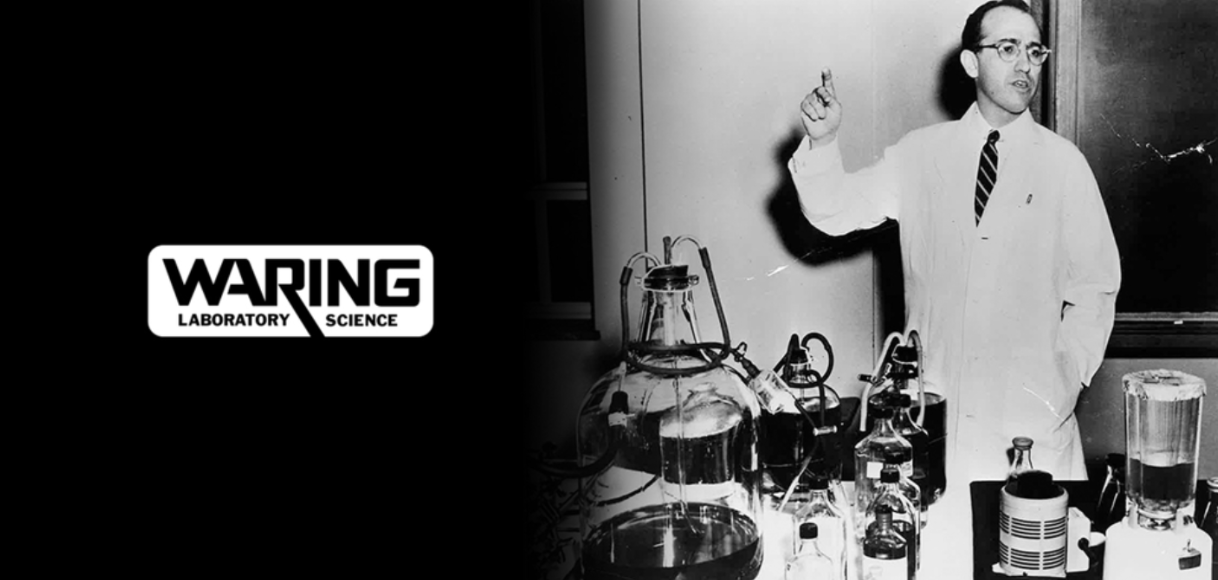
Kitchen Counters and Viral DNA A retrospective image from Waring Laboratories (1950s) shows a lab researcher working with a Waring blender in vaccine development. “In the 1950’s a Waring® blender was used in the development of the polio vaccine,” notes the Waring website — illustrating how an ordinary appliance found its way into serious lab work. Long before disposable plasticware, biologists repurposed kitchen gear. For example, Alfred Hershey and Martha Chase used a high-speed kitchen blender in their classic 1952 experiment on bacteriophages. They infected E. coli with radioactive phages, then “stirred each sample in a Waring Blender” to shear off viral protein coats (since centrifuges would destroy the cells). The blender’s mechanical force stripped away protein shells while leaving cells intact. This enabled Hershey and Chase to show that only the DNA (phosphorus-tagged) entered the cell, whereas viral protein stayed outside. In short, the humble blender helped clinch the discovery that DNA is the genetic material. This isn’t an isolated case. In the late 1940s Jonas Salk used a Waring blender to help prepare inactivated virus for polio vaccine trials. More broadly, even today laboratories use motorized blenders to homogenize tissues or mix reagents when gentle blending is needed. The story of the Waring blender reminds us that scientific breakthroughs can rely on off-the-shelf gadgets. As one historian put it, that “Waring blender experiment… showed that when bacteriophages infect bacteria, their DNA enters the host cell, but most of their protein does not,” confirming DNA’s role. A kitchen appliance had reshaped biology.
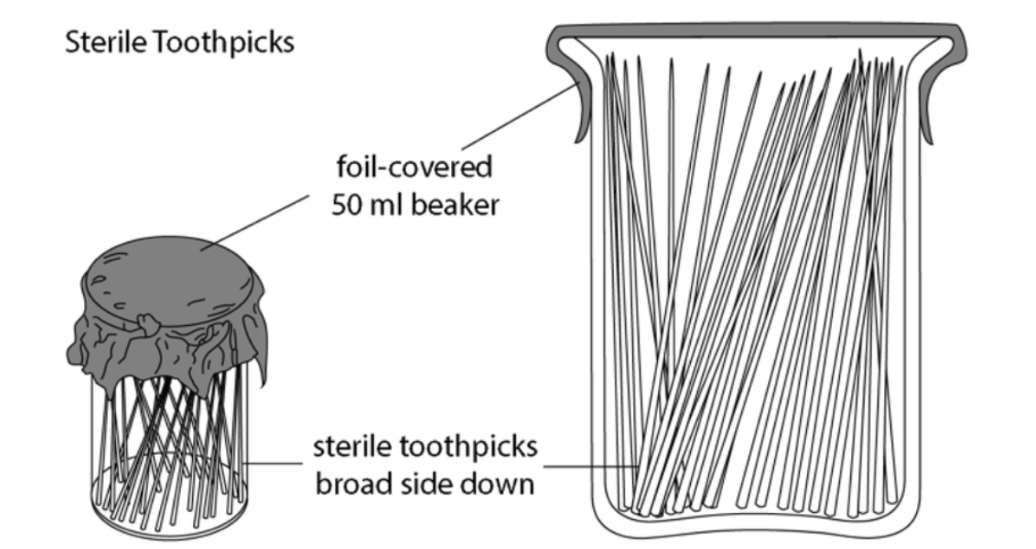
The Mighty Toothpick in Microbiology Even more basic than a blender, the tiny wooden toothpick is a mainstay of the microbiology lab. Researchers routinely sterilize thin wooden toothpicks (for example by aluminum foil wrapping and autoclaving) for manipulating cultures. Lab guides explicitly list “sterile toothpicks” among needed tools. According to Fraser et al., “The broad side of flat wooden toothpicks may also be used for streaking out bacteria,” and a pointed toothpick end is handy to “pick individual colonies or phage plaques.” In practice, scientists use toothpicks to transfer tiny spots of liquid, scrape colonies off agar plates, or inoculate bacteria into broth. This simple method is faster and cheaper than disposable pipette tips for many tasks. For instance, when testing mutant bacteria or phages, a researcher might dip a sterile toothpick into a colony and touch it onto a new plate. Textbooks today still list toothpicks side by side with loops and spreaders as basic microbiology supplies. In other words, no robot is needed to pick single clones: a sharpened toothpick does the job! Using toothpicks and plates, microbial geneticists have answered big questions. For example, Max Delbrück and Salvador Luria’s 1943 fluctuation test relied on plating bacterial cultures in batches and observing the numbers of phage-resistant colonies. By carefully counting colonies on Petri dishes (often using a toothpick to isolate a survivor), they showed that mutations occur spontaneously, not only in response to viruses. In modern teaching labs, similar experiments still use nothing fancier than agar plates, broth, and small sticks. Such “cheap and cheerful” tools underscore how even fundamental genetics can be explored with minimal gear.
Garden Experiments and Germs Before advanced machines, scientists employed whatever was at hand. Gregor Mendel famously used pea plants in his monastery garden to unlock the laws of inheritance. He performed “thousands of crosses with pea plants,” tallying traits by hand and discovering dominant versus recessive patterns. His only tools were pea pods, a fence for pollination, and his notebook. Likewise, Louis Pasteur employed simple glassware to settle the question of spontaneous generation. In 1859 he boiled broth in a long-necked glass flask bent like a swan’s neck. As the broth stayed sterile (dust trapped in the curve), he demonstrated that microorganisms come from the air, not spontaneously. The broth remained clear until Pasteur tipped the flask so particles could fall in, at which point it quickly clouded. This elegant setup — no microscopes or fancy gadgets, just heat and cleverly shaped glass — provided key evidence for germ theory. In each of these cases, the basic “tool” was just the experimental design plus everyday objects: pea plants and garden fences, or flasks and heat. Today’s students still recreate Pasteur’s experiment with flasks and coils of tubing, proving that crucial insights can come from very simple means.
Building Physics from Boards and Beads Physics has its share of kitchen-lab stories too. In the late 1500s, Galileo Galilei challenged Aristotle by letting bronze balls roll down wooden ramps. Using nothing more than a straight board with a carved groove and a stopwatch (or water clock), he showed that the distance traveled grew with the square of time — a precursor to the concept of acceleration. Galileo’s setup was so modest that contemporary scholars can literally replicate it with two planks of wood and a ball. About a century later, Isaac Newton explored light with a cut glass prism. In his Opticks (1704) he describes passing sunlight through a prism and observing the spectrum of seven colors. Newton’s lab was primitive by modern standards; the “apparatus” was sunlight, a small aperture in a window shutter, and a prism of glass. Yet from this he laid the foundation for optics and identified red, orange, yellow… and indigo in the rainbow. As Smithsonian exhibition notes, Newton “demonstrated that clear white light was composed of seven visible colors” — all with a stick of wood and a triangular crystal. Chemistry offers another example. Mikhail Tsvet, a Russian botanist in 1906, took plant extracts (e.g. crushed spinach leaves) and passed them through a column of calcium carbonate. The colored molecules separated along the column and onto filter paper, giving distinct bands. Tsvet dubbed this “chromatography” (literally, “color writing”) [8]. He used little more than glass tubes, filter paper, and solvent — no electronic detectors or lasers. This humble technique became essential for separating mixtures and analyzing compounds. In fact, early chromatography still often uses simple paper strips and beakers as in Tsvet’s day. These stories show that when it comes to probing nature, complex questions can be approached with simple setups. A wooden board, a glass prism, some filter paper — each turned out to be all the “machinery” needed to shake up science.
A Modern Twist: CRISPR from Bacteria Even in cutting-edge biotechnology, the roots of innovation lie in basic experiments. Take CRISPR/Cas9, the genome-editing “scissors” of today. CRISPR itself began as a peculiarity in microbial genetics. In 1987 researchers found unusual repeating DNA sequences in E. coli. It took years of cultivation and observation to realize their function. In 2007, Barrangou and colleagues grew yogurt bacteria (Streptococcus thermophilus) and challenged them with different viruses. They simply traced strains from old culture collections — a kind of years-long microbial experiment — to see what happened. When new viral DNA fragments (called “spacers”) appeared in the CRISPR region of the bacterial genome, those bacteria became immune to that virus. In other words, by watching petri dishes and DNA sequences over time, they uncovered a bacterial adaptive immune system. This discovery, grounded in basic bacterial culture techniques, gave us the CRISPR tool. Now molecular biologists use CRISPR/Cas9 to cut and paste genes in cells, but it all started with simple lab work: growing microbes, infecting them with phages, and sequencing DNA. In this way, a fundamental question of immunity and evolution was answered using humble methods, yet it led to one of the most powerful tools in biotechnology.
From Humble to High-Tech These examples span centuries and fields, but they share a lesson: great science often builds on simple tools. It could be a tablespoon blender or a paperclip in the right setting; a painstaking count on graph paper or a wooden toothpick to dot microbial lawns. As Jeremy Norman notes of the Hershey-Chase work, their “Waring Blender experiment” settled the old debate by showing DNA is the hereditary material [2]. Today Caltech students and researchers still repeat the same principles. Whether measuring cosmic expansion with a telescope or editing genomes with CRISPR, the discovery process remains grounded in creativity. In the end, a blender, a toothpick and even the modest bacterial immune system are part of the same story: they became the instruments that carried scientists from questions to answers. Their legacy reminds us that you don’t always need high-end machinery to unlock the universe. Even the simplest tools — used thoughtfully — can deliver groundbreaking results.
Sources: Classic experiments by Hershey & Chase [1] and by Jonas Salk [3]; lab manuals and methods [4][5]; historical accounts of Galileo, Newton, Pasteur, Mendel [6][7][9][10]; and reviews of CRISPR discovery [12][13]. These illustrate how basic tools — from kitchen blenders to bacterial cultures — have propelled science.