
Dimming the Sun: Can a Satellite Fleet Buy Earth the Time It Needs?
An interview with Pedro Neves, a visiting researcher from JPL.
When I first met Pedro Neves, a visiting researcher from NASA’s Jet Propulsion Laboratory, it was at a Watson Lecture in October 2025. Our shared native language, Portuguese, provided an immediate shorthand, but the conversation quickly moved to the mechanics of the Sun-Earth L1 Lagrange point. Neves was describing a plan to stabilize the global climate by installing a microscopic sunshade 1.5 million kilometers from Earth.
Pedro’s path to the Mission Control Center in Pasadena was shaped by a choice in his final year of high school in Portugal: medical school or aerospace engineering. He chose the latter, but the objective remained clinical. “I grew up believing we should strive to contribute positively to society,” Neves said. He completed a bachelor’s degree in aerospace engineering at the University of Lisbon before moving to Italy for a master’s program in space engineering, seeking the intersection where orbital mechanics meets terrestrial survival.
In 2020, while researching how satellites could combat wildfires for a European Space Agency competition, he began to realize the potential of space to address environmental crises. This research provided a foundation for leveraging orbital assets to mitigate disasters in real time. At JPL, this same logic underpinned his work on DimSun: if satellites could assist in managing localized fires, could a coordinated swarm of spacecraft do the same for the planet’s thermal runaway?
The mission Pedro joined, DimSun, departs from earlier geoengineering concepts. Led by JPL Robotics Technologist Dr. Saptarshi Bandyopadhyay, the project’s architecture has matured from asteroid mining to a more controlled, Earth-launched model. “The advantage of making the particles on Earth is that we can more easily control their production in terms of their characteristics, such as size and sphericity,” Neves explained. The current blueprint utilizes engineered spherical particles that are 90% hollow with a radius of just 0.3 μm. These reflectors are designed with a high charge-to-mass ratio, allowing them to interact more efficiently with solar rays and the electric fields intended to contain them.
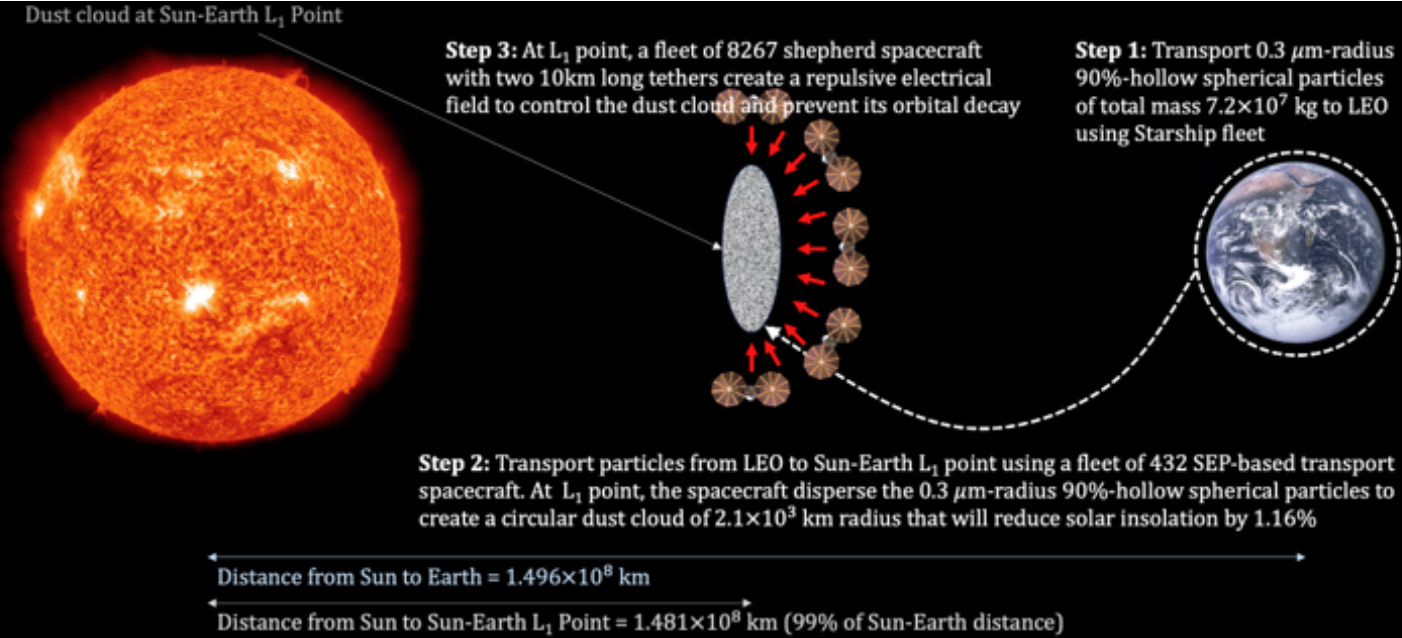
Getting the material into space is only the first half of the problem; the second is keeping it there. The target is the Sun-Earth L1 Lagrange point, a gravitational sweet spot. Because L1 is an unstable equilibrium, any object placed there will naturally drift away without constant correction. Pedro’s primary contribution was to demonstrate the feasibility of the mission’s “brain” through custom MATLAB simulations. His work provided the physical proof that a fleet of 8,267 shepherd spacecraft could maintain the cloud’s geometry through electrostatic superposition. By deploying 10-kilometer-long tethers, these shepherds create a repulsive Coulomb field to counteract the solar radiation pressure (SRP) that would otherwise blow the cloud into deep space.
“Probably the biggest challenge was to balance the Coulomb field strength with the inter-spacecraft spacing without overcorrecting,” Neves noted. Because Coulomb forces are highly sensitive to distance, the system requires a degree of autonomous precision that pushes the boundaries of current robotics. This precision allows for a calculated safety valve. Using Beer-Lambert law, the team can determine the required optical depth and cloud area needed to achieve a 1.16% reduction in solar irradiance, the amount required to maintain a 1.5°C target under current warming trajectories. If the mission needed to be aborted, the physics of the L1 point acts as a kill switch. “Once the shepherd spacecrafts cease exerting electrostatic forces, solar radiation pressure immediately dominates,” Pedro explained. Within 100 days, the sun’s own pressure would sweep the cloud away, making the intervention reversible.
The economic argument for DimSun is as grounded as the physics. Economic losses due to global warming are already estimated to exceed $140 billion annually, with projections estimating losses of $1 trillion in the coming decades. In this context, the DimSun mission concept, estimated at $134 billion, is a cost-effective alternative. It is significantly cheaper than solid space-based occultors (estimated at $20 trillion) and competes favorably with the costs of terrestrial carbon capture and storage. Neves views it as an insurance policy: “Given the uncertainty surrounding the pace of global decarbonization, it is prudent to invest in complementary risk-reduction strategies… as a contingency measure”.
Pedro Neves is clear about the project’s limitations. He is firm that this is a “time-buying tool,” not a substitute for decarbonization. “Emissions reductions remain absolutely essential,” he emphasized. His work aims to provide an initial assessment of which solar-based geoengineering concepts warrant further study, fostering collaboration between the space engineering and climate modeling communities.
This spirit of collaboration is something Neves carried from his four-month tenure as a Visiting Student Researcher at JPL. Coming from a more traditional, hierarchical academic environment in Southern Europe, the “flat” hierarchy of Pasadena was a revelation. “I quickly realized that a collaborative and welcoming culture is a symbol of JPL,” he said. “Everyone I met fostered an atmosphere where dialogue is encouraged and diverse perspectives are genuinely valued”. He was inspired by researchers like Dr. Bandyopadhyay, who devote significant personal time to unfunded initiatives driven by a desire to innovate.
As Pedro concludes this research chapter, he carries with him the JPL approach to solving technical hurdles. He remains the same researcher who looked at wildfires and saw an opportunity for orbital intervention, now realizing that by herding a satellite fleet at L1, he contributed to a project attempting to stabilize a planet in critical condition. “Humanity’s intricate curiosity and drive to explore the cosmos are defining traits of our species,” Neves reflected, “but discovering new ways of using space to improve life on Earth allows us to continue thriving here on our pale blue dot.”
Technical data and specifications in this article are derived from a published mission concept paper and original interviews with visiting researcher Pedro Neves.