
All 22 National Science Board Members Removed
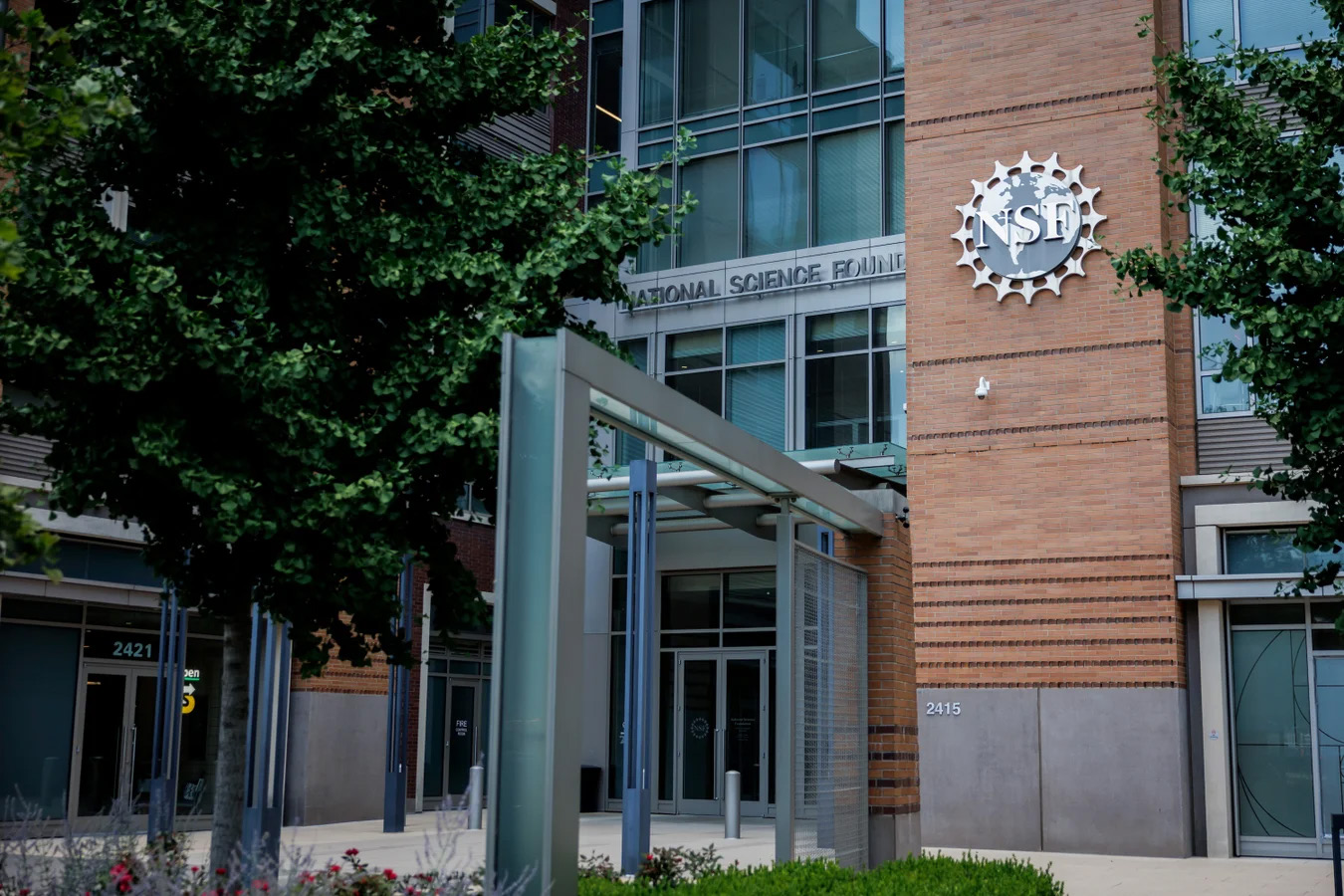
(Photo: Bloomberg/Getty Images)
All 22 members of the National Science Board (NSB), which oversees the National Science Foundation (NSF), were removed on April 24 without explanation. Members were notified by email that their positions were “terminated, effective immediately.” They included Aaron Dominguez (BS ’92), the board’s vice chair and provost of the Catholic University of America, and board member Matthew Malkan (PhD ’83), a UCLA professor.
The dismissal of the board comes after more than a year of major changes at the NSF under the current administration. Since last year, the agency has terminated more than 1,700 grants, with many cuts affecting projects related to areas deemed inconsistent with agency priorities. New awards also slowed sharply, with the agency awarding roughly half as many grants in early 2025 as it had during the same period in 2024. Additionally, the NSF faced significant personnel losses, including the firing of nearly 10% of its workforce in February 2025. It also disestablished 12 nonstatutory advisory committees, including those for environmental research and education, mathematical and physical sciences, geosciences, and STEM education.
Willie E. May, a former NSB member and former director of the National Institute of Standards and Technology, told NPR, “I have watched the systematic dismantling of the scientific advisory infrastructure of this government with growing alarm, and the [NSB] is simply the latest casualty.” Gennady Samorodnitsky, a Cornell University professor, said, “It is the task of the government to figure out what’s best for society. The money comes from the government, so ultimately [the government] makes the decisions.”
In 1950, Congress established the NSF “to promote the progress of science; to advance the national health, prosperity, and welfare; to secure the national defense; and for other purposes.” The NSB works with the NSF director to advance the NSF’s mission, including to “recommend and encourage the pursuit of national policies for the promotion of research and education in science and engineering.”
The board’s dismissal also comes as the NSF has been without a Senate-confirmed director since April 2025, when Sethuraman Panchanathan, an Arizona State University professor, resigned. In March 2026, Jim O’Neill was nominated as director and is awaiting Senate confirmation. “Traditionally, NSF directors have had a solid research career and a strong familiarity with NSF processes, while O’Neill’s background is in finance and investments,” said Yolanda Gil, a University of Southern California professor and terminated NSB member.
O’Neill previously held a senior role at the Department of Health and Human Services (HHS) during the George W. Bush administration before working for several organizations associated with Peter Thiel, the co-founder and chairman of Palantir. He worked at Thiel’s Clarium Capital, later served as managing director of Thiel’s Mithril Capital Management and CEO of the Thiel Foundation, and returned to government in the second Trump administration as deputy HHS secretary. Nature reported that, if confirmed by the Senate, O’Neill would become the first NSF director who is not a scientist or engineer.
The law that established the NSF gives the NSB a role in selecting the agency’s director, stating that “the Board may make recommendations to the President with respect to the appointment of the Director, and the Director shall not be appointed until the Board has had an opportunity to make such recommendations.”
NSB members are appointed for six-year terms, with one-third of the board appointed every two years. Under federal law, nominees must “be eminent in the fields of the basic, medical, or social sciences, engineering, agriculture, education, research management, or public affairs.”
The board also sets NSF policy within priorities established by the president and Congress, helps identify key issues for the agency, and approves strategic budget directions and major programs. In addition, it serves as an independent body of advisers to both the president and Congress on science, engineering, and education policy.
At the time of the dismissals, the NSB was preparing a report related to the state of American science. Roger Beachy, a professor emeritus at Washington University in St. Louis and former board member, confirmed that the report focused on “findings of a statistical unit of the agency that further describes the growing funding gap between support for research between the U.S. and China.”
Some dismissed members also said the board’s oversight role had already been limited before the firings. According to Nature, multiple NSB members said the White House Office of Management and Budget instructed NSF leadership to withhold details about the agency’s spending from the board. “We were told that those plans were solely going to be with NSF leadership,” said Victor McCrary, the former NSB chair. “And leadership was told not to share this with anybody else, including the board.”
When asked why the NSB members were terminated, a White House spokesperson cited the 2021 Supreme Court ruling in United States v. Arthrex, Inc., saying it “raised constitutional questions about whether non-Senate confirmed appointees can exercise the authorities that Congress gave the National Science Board.”
Since a 2012 law changed the appointment process for several government positions, NSB appointments are no longer required to undergo Senate confirmation. The board recommends new members, but the president ultimately decides whom to appoint.
H. Jefferson Powell, a Duke University professor and scholar of constitutional law and executive power, said there is “a puzzling disconnect” between the decision to fire the board members and the White House’s explanation. If Arthrex applies, “eliminating the [NSB] members leaves it unaddressed.”
Rep. Zoe Lofgren, D-Calif., the ranking Democrat on the House Committee on Science, Space, and Technology, said, “If there was a legitimate concern on the part of the Trump Administration on a legal issue, the path forward is not to fire the entire NSB — one third of whom he appointed in the first place — but to work with Congress.” Sen. Maria Cantwell, D-Wash., of the Senate Committee on Commerce, Science, and Transportation, said in a statement, “The abrupt termination of members of the [NSB] represents a dangerous attack on the institutions and expertise that drive American innovation and discovery.”
“Every President expects advisors to serve in a manner consistent with executive and legislative priorities,” Rep. Brian Babin, R-Texas, who chairs the House Science, Space, and Technology Committee, wrote to NPR. “I look forward to seeing whom President Trump selects to fill the NSB and refocus our science agencies on their core mission: pursuing science.”
As of May 17, the White House had not announced when it would appoint replacements for the dismissed board members. Some former members questioned the NSF’s future independence after the removals. Professor Beachy asked Nature, “Will we turn into an agency that is directed by the White House, or will we have an agency directed and managed by science and scientists?”