
The Strange Attractor — Did Caltech Host the World’s First Successful Gathering of Time Travelers?
Editor’s Note: What follows is an extract from an achronological artifact recently found on the steps of the Tech’s Pasadena office building: an apparent dispatch from the future, inexplicably recovered in time for our May 19 issue.
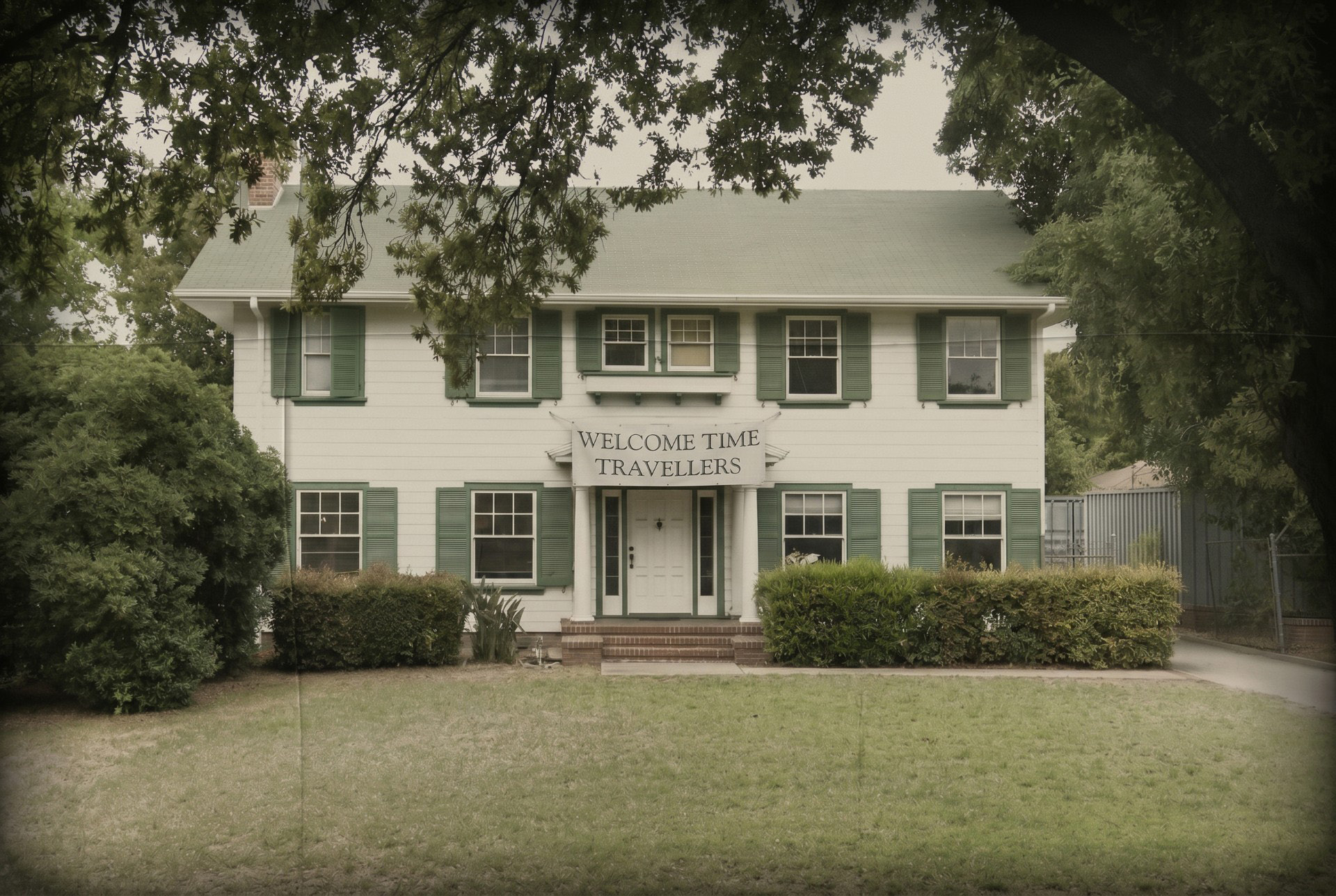
TACIT House on 275 S. Hill Avenue, made time-traveling haven. (Image: Kari Coleman)
Most parties don’t become history. But the ones that do tend to share a quality: the people who were there can’t quite agree on what happened, and the people who were not there can’t stop wondering.
I am one of those who was not there.
The date in question was Friday, May 29, 2026, just as senior classes ended for the year on the Caltech campus. I had a conflict that evening with a Dabney House retreat. Twenty years later, I remain uncertain about what happened at the event I missed — though I have thought about it more than is probably reasonable, and spent no small amount of time wishing I had been able to attend.
It was advertised as a “time travel gathering.” Stuart Candy, a futurist and Caltech Theater’s artist-in-residence for the 2025-26 academic year, had begun the year with an “immersive futures jam”: a workshop in which students, staff and faculty spent a weekend co-creating and staging possible Pasadenas, thirty years out. I took part in that October experiment myself. Two decades on, I cannot say that we seem to be heading toward any iteration of 2055 imagined back then, but I remember the exercise as strange, generous, and joyously destabilizing.
This May gathering at TACIT House was conceived as both the closing of that arc and its inversion. Rather than asking participants in 2026 to inhabit possible futures, it asked possible futures to return the favor.
Time travelers from any year were invited, once only, for two hours on the evening of Friday, May 29. MIT had attempted something similar in 2005. Stephen Hawking tried it at Cambridge in 2009. Both, famously, produced null results.
What distinguished the Caltech version was not quite confidence, but framing. Candy and Kari Coleman, who hosted the event, kept using the word “experiment,” and they meant it.
Spiros Michalakis of the Institute for Quantum Information and Matter (IQIM), who helped design the gathering, told me in a 2036 interview marking its tenth anniversary that the idea was less to issue an ordinary social invitation than to construct a strange attractor — a region in epistemic space in which the present could interact with parallel futures.
“We were not guaranteeing this would work,” Michalakis said. “We were seeking to establish conditions under which it could.”
When I asked whether he thought visitors had come, he smiled.
“I don’t know,” he said. Then, after a moment: “I find it interesting that I don’t know.”
Others who attended have been only marginally more helpful. The basic contours of the evening seem stable enough: the emcee, Ahmed Best of Star Wars fame, was by all accounts luminous; the food and drink were good; the conversations were Caltech-intense; and the musical performances were, in the manner of good Caltech-adjacent programming, slightly more arresting than anyone had been prepared for.
After that, the accounts begin to shear.
Over the past six months, two dozen confirmed attendees have described the gathering to me. Their stories share a peculiar trait: none can be disproven, none directly contradict one another, and yet they do not quite assemble into a single event.
A Caltech physics professor, then a postdoc, remembers meeting a man who quoted to her, verbatim, the final sentence of a paper she was still struggling to write — and that would not be published for more than a year.
A senior who remained at TACIT for the full two hours remembers witnessing a girl draw something elaborate on a napkin, hand it to one of the IQIM researchers, and vanish before anyone thought to ask whose child she was.
An alumnus of Lloyd House, now a structural biologist in Geneva, recalls a forty-minute conversation, mostly about his brother, with a woman whose accent he could not place. The woman, he says, knew things she had no way of knowing. At the end of their conversation, she pressed a coin into his hand and excused herself. He has kept it. He let me see it but not hold it, and asked that I not describe it.
“There were rules in play,” one of my classmates told me. “Or maybe not rules, exactly. I don’t know what was happening. But there was a hidden logic to it.”
Twenty years on, the myth has only grown. Physicists continue to debate its significance. As if it were some geeky Woodstock, far more claim to have been present than could possibly have fit at the venue.
Meanwhile, as I write, there is a gradually yellowing copy of the physical invitation in the Caltech Archives, and another at the Huntington Library — safeguards, the organizers said, to ensure that the coordinates of the gathering would remain available to distant future generations.
As far as I have been able to determine, the invitation remains open.
The Tech has always had a peculiar relationship with its own archives. So if this piece has somehow reached you before May 29, 2026, then the event registration link is at timetravelgathering.com. I cannot promise it works — but if it does, and if you can go, I hope you do.
Please tell me what really happened. I’ve been waiting decades to find out.