
Artemis II Returns Crew to Earth, Demonstrates New Recovery Operations for Lunar Missions
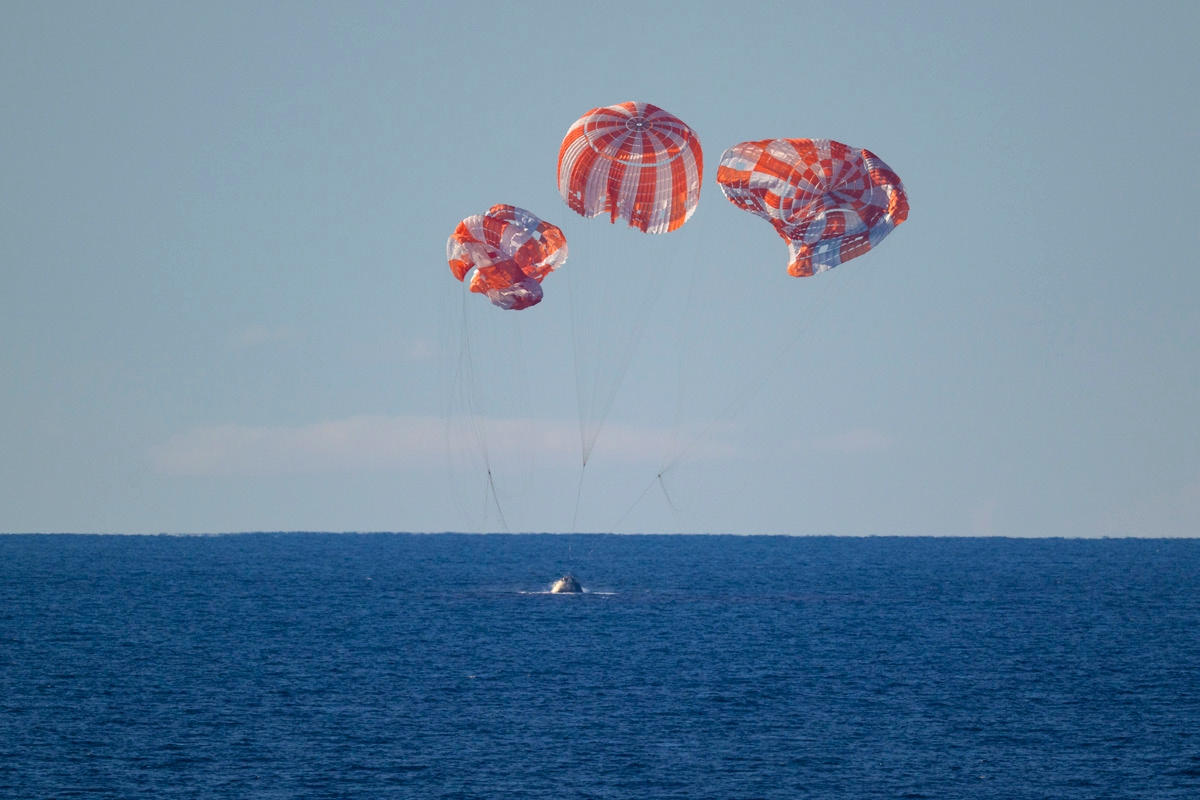
NASA’s Orion spacecraft splashes down in the Pacific Ocean off California on April 10 at 5:07 p.m. PDT, concluding a nearly 10-day lunar mission. Recovery teams from NASA, the U.S. Navy, and the U.S. Air Force then begin bringing the crew and capsule aboard the USS John P. Murtha. (Photo: Bill Ingalls/NASA)
NASA’s Artemis II mission concluded April 10 with a Pacific Ocean splashdown, returning four astronauts from humanity’s first crewed journey to the Moon in more than 50 years and marking a critical step toward future lunar landings.
The Orion spacecraft, carrying NASA astronauts Reid Wiseman, Victor Glover, and Christina Koch, alongside Canadian Space Agency astronaut Jeremy Hansen, touched down off the coast of California after a nearly 10-day mission that sent the crew more than 250,000 miles from Earth at its farthest point. The flight set a new distance record for human space travel and served as the first crewed test of NASA’s Space Launch System and Orion capsule.
Following splashdown, Artemis II also debuted a revised recovery strategy. Rather than retrieving the spacecraft inside a ship’s well deck before crew egress, as in the uncrewed Artemis I mission, recovery teams conducted an open-water extraction. Navy divers stabilized Orion using an inflatable collar and platform, allowing astronauts to exit one by one and be airlifted by helicopter to a nearby amphibious recovery ship for initial medical evaluation.
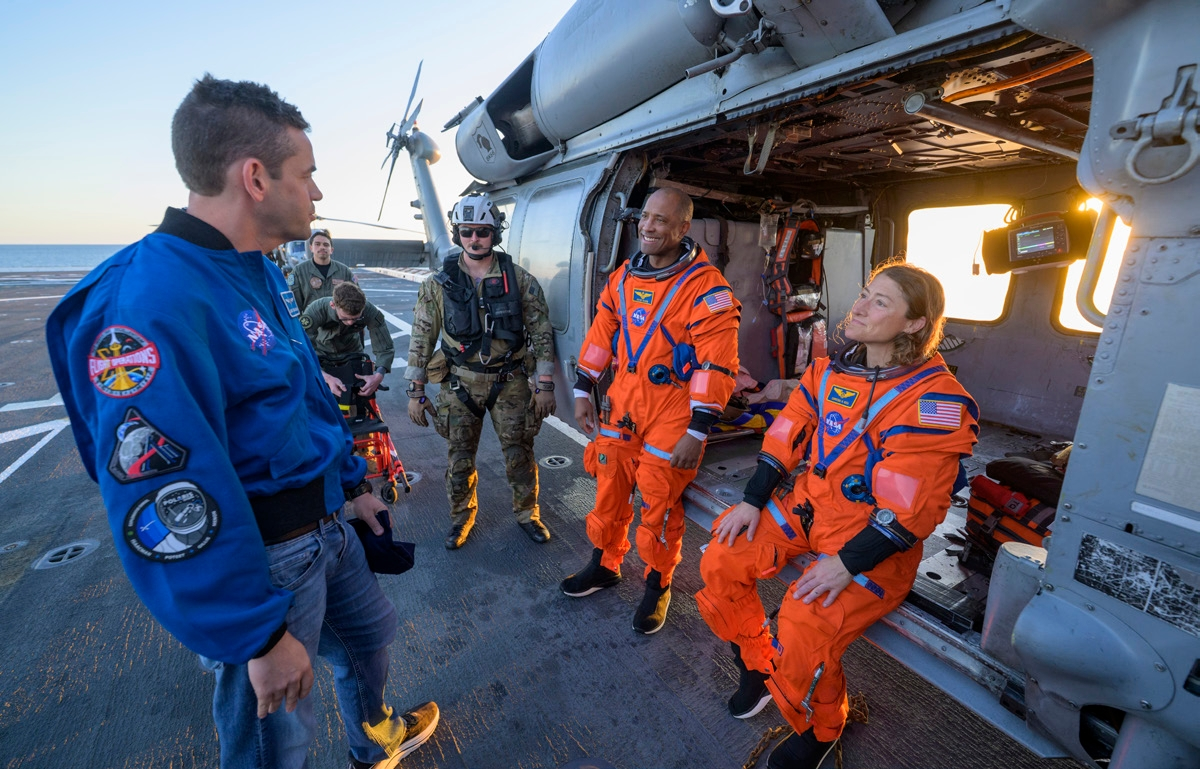
NASA astronauts Victor Glover and Christina Koch speak with NASA Administrator Jared Isaacman aboard the USS John P. Murtha after their recovery from Orion. (Photo: Bill Ingalls/ NASA)
The capsule itself was later secured and transported aboard the vessel. The interagency recovery drew on personnel from NASA and the U.S. military, including Navy divers and Air Force weather specialists, alongside engineering teams from Kennedy Space Center and Johnson Space Center. Additional operations included tracking and retrieving jettisoned hardware such as parachutes and the forward bay cover, enabling engineers to assess system performance for future missions.
Beyond its technical achievements, Artemis II carried significant symbolic weight. The crew described the mission as both a scientific milestone and a shared human experience, stressing its worldwide impact. “We wanted to … bring the world together,” commander Reid Wiseman said after returning, noting the widespread public engagement with the flight.
During the mission, astronauts tested life-support systems, conducted manual piloting demonstrations, and gathered data on human performance in deep space — crucial inputs for Artemis III, which aims to return astronauts to the lunar surface. They also captured thousands of images of the Moon and conducted experiments on the effects of microgravity and radiation.
With Orion and its crew safely recovered, NASA is now shifting focus to the next phase of the Artemis program: integrating lunar landers and preparing for sustained human presence on the Moon.
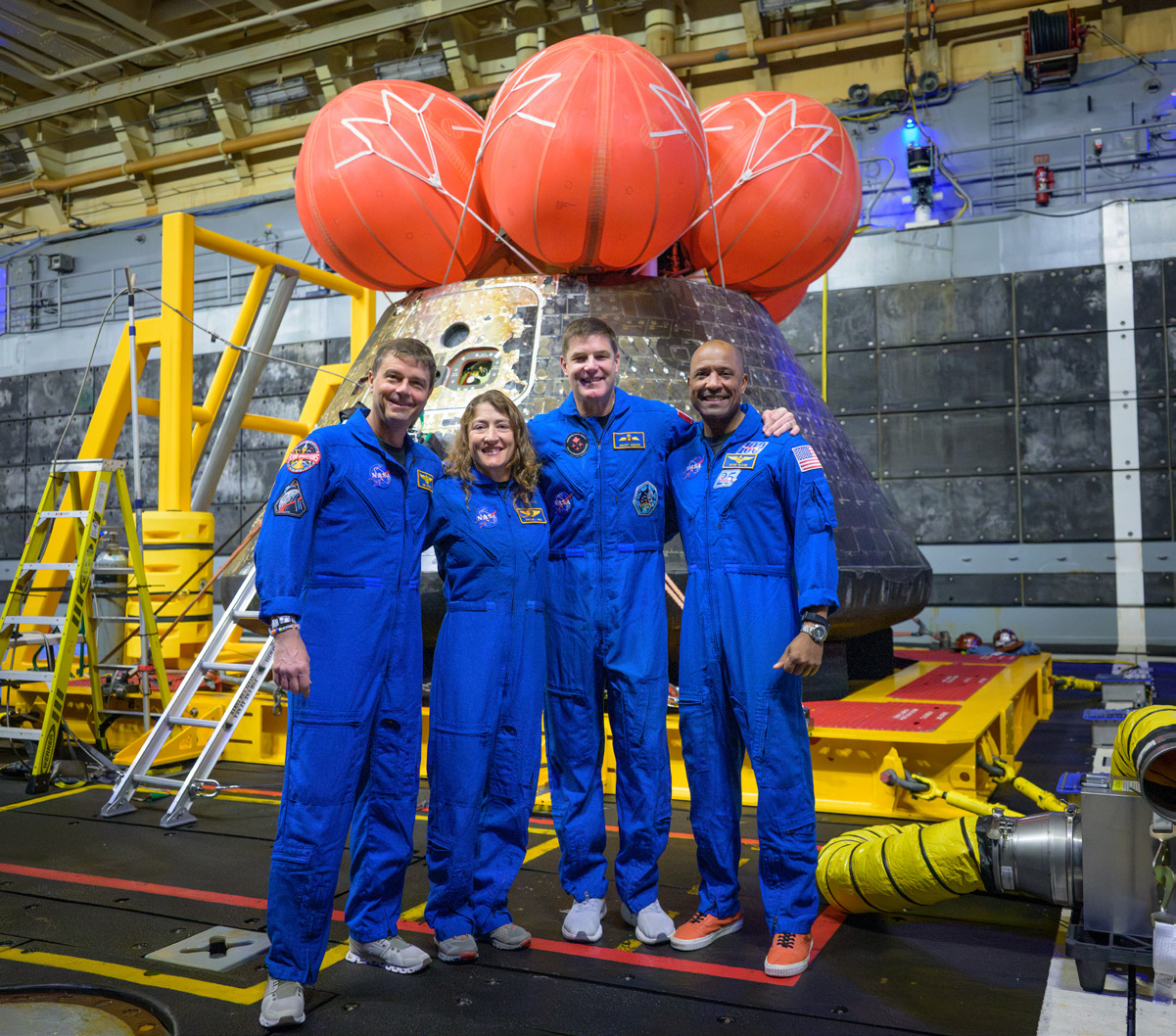
Artemis II crew members Reid Wiseman, Christina Koch, Jeremy Hansen, and Victoria Glover pose aboard the USS John P. Murtha after viewing the Orion spacecraft following splashdown on April 11. (Photo: Bill Ingalls/NASA)